
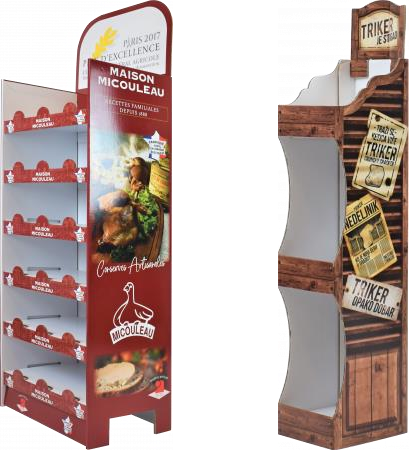
When a brand wants to showcase its products in a retail environment, choosing the right type of POS display is essential.
Among the most common solutions, two formats are widely used: the floor display and the counter display.
Both can improve product visibility, but they serve different purposes. Their effectiveness depends on several factors, including product size, available space, consumer behavior, and the duration of the promotional campaign.
So, floor display or counter display: which one should you choose?
1. What is a floor display?
A floor display is a freestanding POS display placed directly on the floor.
It can be positioned in an aisle, at the end of a shelf, near a product category, or in a promotional area.
Its height generally makes it visible from several meters away and provides a large communication surface.
It can include: multiple shelves; hooks; compartments; a header or topper; side panels; storage space; various graphic elements.
A floor display is particularly suitable when a brand wants to create a strong visual presence in-store.
2. What is a counter display?
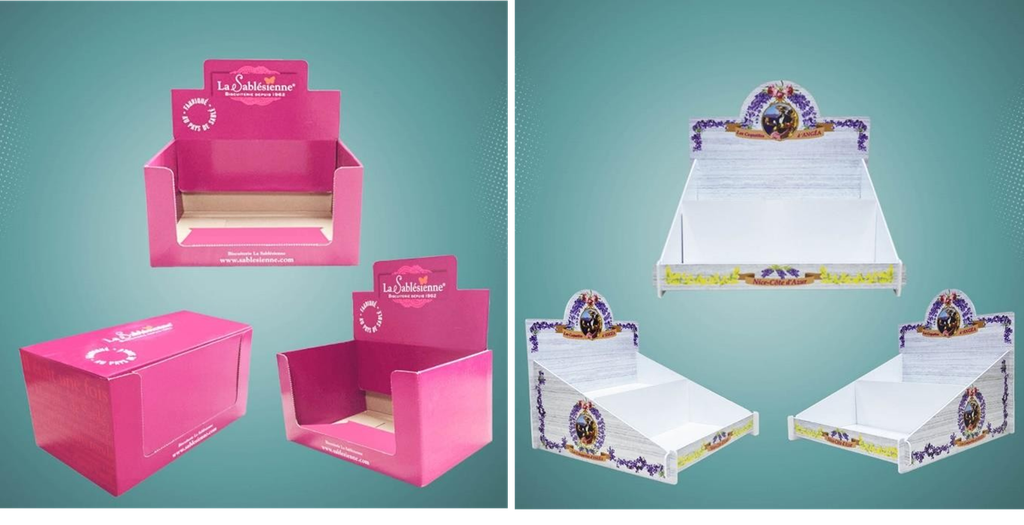
A counter display is a much more compact format.
It is designed to be placed on:
- a counter;
- a checkout area;
- a table; a shelf;
- a retail fixture.
Its main purpose is usually to highlight a small selection of products in a limited space.
It is especially effective when the customer is already very close to the display.
This format is often used for:
- small products;
- accessories;
- confectionery;
- cosmetics;
- impulse-purchase items; samples; new products.
3. Floor displays offer greater visibility
One of the main advantages of a floor display is its size.
Thanks to its height and large graphic surface, it can be seen from a distance.
A header positioned at the top can be used to display:
- the logo;
- a promotion;
- a slogan;
- a product image; a commercial message.
The display can therefore attract the shopper’s attention before they are standing directly in front of the products.
This is particularly useful for:
- product launches;
- promotional campaigns;
- seasonal promotions; new product ranges; in-store activations.
- Counter displays encourage impulse purchases
Counter displays are often positioned much closer to the final purchasing decision.
When placed near a checkout or waiting area, they can encourage customers to spontaneously add an extra product to their basket.
This works particularly well for products that are:
- small;
- easy to understand;
- affordably priced;
- complementary to the main purchase.
For example, a customer waiting at the checkout may notice a small product they had not originally planned to buy.
The close proximity between the shopper and the product can therefore help trigger an impulse purchase.
- How many products do you want to display?
The number of products is an important factor.
Floor display
With several levels, a floor display can hold a significant quantity of merchandise.
It is particularly suitable for presenting:
- several references;
- different flavors;
- multiple sizes;
- a complete product range.
A higher capacity can also reduce the frequency of restocking.
Counter display
Its capacity is naturally more limited.
It is better suited to:
- a single product reference;
- a few variations;
- a selected range;
- smaller quantities.
A counter display should remain compact enough not to clutter the sales area.
6. What size are your products?
Product dimensions also play an important role.
A small accessory, confectionery box, or cosmetic item can easily be displayed on a counter unit.
Larger products, however, usually require more space.
In this case, a floor display may be more appropriate.
It can be designed with:
- deeper shelves;
- wider compartments;
- longer hooks;
- structures capable of supporting heavier loads.
The display design should always take the total loaded weight into account.
7. Available space in-store
Not every retail environment has the same amount of space.
In a small shop, a floor display may sometimes obstruct customer circulation.
A counter display can make use of an existing surface without requiring additional floor space.
In contrast, in a supermarket or a store with wide aisles, a floor display can create a fully independent promotional area.
Before selecting the format, it is therefore important to consider:
- available space;
- aisle width;
- intended location; viewing distance; existing store furniture.
- Floor displays allow more storytelling
Their larger surface area offers more opportunities for communication.
The sides, header, shelves, and base can all be customized.
The brand can therefore create a complete visual universe around the product.
For example, the display can include:
- illustrations;
- photographs;
- specific brand colors;
- die-cut elements;
- product information; seasonal graphics.
The display can almost become a small branded environment within the store.
- Counter displays need to get straight to the point
Because the available graphic space is smaller, the message must be particularly simple.
An effective counter display often relies on:
- a clearly visible logo;
- a short headline;
- an easily accessible product;
- a strong color;
- a clearly identifiable price or offer.
There is usually no need to include a large amount of information.
Because the shopper is already close to the product, the main purpose of the display is to encourage them to notice or pick it up.
- Which format is best for a product launch?
For a major launch, a floor display generally provides greater impact.
It can create a strong visual break within the retail environment.
A brand can use it to showcase:
- several products;
- a new visual identity;
- a complete campaign;
- a specific product universe.
However, a counter display can also be used as a complementary tool.
A campaign could, for example, combine:
floor displays in key retail areas + counter displays near checkout points.
This gives the brand several opportunities to reach the shopper throughout the store.
- Which format is best for a temporary promotion?
Both solutions can work well.
It mainly depends on the scale of the campaign.
For a major promotion involving several products, a floor display will generally be more suitable.
For a short-term offer focused on a small product, a counter display may be enough.
Cardboard is widely used for both formats in temporary campaigns because it offers extensive customization while remaining lightweight.
- Transportation and storage
Logistics should also be considered.
A counter display is generally:
- more compact;
- lighter;
- easier to transport; easier to store.
It can often be delivered flat-packed and assembled quickly on-site.
A floor display requires more space, especially when hundreds of units need to be shipped.
However, its design can be optimized to reduce transportation volume.
The assembly system should therefore be considered from the very beginning of the design process.
13. What budget should you plan for?
The cost depends on several factors:
- material;
- dimensions;
- structure;
- quantity;
- printing;
- finishes;
- accessories.
A counter display generally uses less material than a floor display.
It can therefore be an attractive option for large campaigns requiring distribution across many retail locations.
A floor display requires more material and structural development, but it also provides a much stronger in-store presence.
The cost should therefore be evaluated in relation to the desired impact, rather than simply choosing the cheapest option.
14. When should you choose a floor display?
A floor display is particularly recommended when you want to:
- achieve strong visibility;
- display several product references;
- present a large quantity of products;
- create a branded environment;
- launch a new product range;
- run a major promotional campaign;
- occupy a dedicated area within the store.
It is especially well suited to campaigns that require a strong visual presence.
15. When should you choose a counter display?
A counter display is particularly suitable when you want to:
- present small products;
- encourage impulse purchases;
- use minimal space;
- position a display close to the checkout;
- highlight a new product;
- display a small number of references;
- easily equip a large number of retail locations.
It is a compact and effective solution when available space is limited.
16. Why not use both?
For some campaigns, the best solution is to combine both formats.
The floor display can create the first interaction with the brand in the main retail area.
The counter display can then remind the shopper about the product when they reach the checkout.
This strategy increases the number of opportunities to see the product without necessarily repeating exactly the same message.
The floor display can focus on the overall brand universe, while the counter display can emphasize a specific product or promotional offer.
Comparison table
Criteria Floor Display Counter Display
Visibility from a distance Very high More limited
Product capacity High Low to medium
Communication surface Large Limited
Space required Higher Low
Impulse purchase potential Good Excellent
Full range presentation Very suitable More limited
| Checkout placement | Possible depending on space Very suitable |
| Transportation | More bulky More compact |
| Brand storytelling | Excellent More direct |
| Small products | Suitable Very suitable |
Conclusion: the right format depends on your objective
There is no single format that is always better than the other.
A floor display is especially effective for creating visibility, presenting several products, and building a strong branded presence within the store.
A counter display is better suited to small products, limited spaces, and impulse purchases.
Before making your choice, it is therefore important to consider:
- product size;
- quantity to be displayed;
- available space;
- campaign duration;
- budget;
- commercial objective.
At Novobox Displays, each POS display can be custom-designed according to the retail environment, the product, and the brand’s objectives.
Whether it is a floor display or a counter display, the goal remains the same: to make the product more visible, more accessible, and more attractive at the moment when the shopper makes their purchasing decision.
🌐 www.novoboxdisplays.com
📧 manufacturing@ novoboxworld.com